Discovery’s Shark Week 2026 investigates whether Great White sharks can learn complex tasks using behavioral techniques originally designed for Navy dolphins.
The depths of the ocean have always held secrets that challenge our understanding of biology and cognition, but few questions are as provocative as the one currently being asked by marine biologists: can sharks be trained? For decades, we have viewed the great white shark as a mindless eating machine, a creature driven entirely by instinct and the scent of blood. However, a groundbreaking investigation into the intelligence of great whites is suggesting that these apex predators may possess a level of mental complexity that rivals some of the most intelligent marine mammals.
As Discovery’s Shark Week 2026 kicks off on Sunday, July 26, the spotlight falls on a controversial science hook that could redefine our relationship with the ocean’s top predators. In the upcoming premiere of How to Train a Great White, premiering Thursday, July 30, at 9 PM ET/PT, the scientific community is taking a page out of the U.S. Navy’s playbook to see if the world’s most feared fish can learn like a dolphin.
Can sharks be trained?
The question of whether sharks can be trained is not entirely new, but the application of advanced behavioral science to great whites represents a massive leap in field research. Historically, the U.S. Navy has successfully used operant conditioning—a method of learning that occurs through rewards and punishments for behavior—to train dolphins and sea lions for complex underwater tasks, such as locating mines or retrieving equipment.
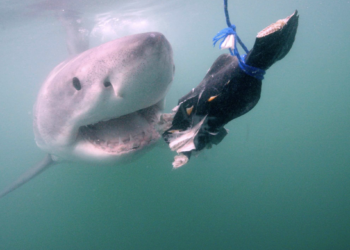
Marine biologist Dr. Tristan Guttridge is now leading an expedition to New Zealand to determine if these same cognitive principles apply to Carcharodon carcharias. The experiment moves beyond simple attraction to bait; it involves testing whether great whites can respond to specific cues and solve problems in a controlled environment. If a shark can associate a signal with a specific action or reward, it proves that their behavior is flexible and subject to cognitive processing rather than just primal reflex.
Intelligence of great whites
To understand how to train a great white, one must first appreciate the existing shark intelligence discovery that has laid the groundwork for this study. Recent observations have shown that great whites are far from solitary, random hunters. In places like the “House of Sharks” off the coast of New Zealand, researchers have documented great whites organizing into competing clans or “houses.” These predators appear to recognize kin, return to ancestral territories, and even engage in rivalries over feeding grounds.
This social structure suggests an advanced level of animal behavior sharks use to navigate their world. Intelligence in the ocean isn’t just about memory; it is about spatial awareness, social recognition, and the ability to adapt hunting tactics in real time. Scientists now believe that these sharks are alpha predators specifically because they are highly intelligent, capable of adapting their techniques based on the specific challenges of their environment.
What the episode attempts
The How to Train a Great White special follows Dr. Guttridge and his team as they venture into shark-infested waters to set up what is essentially an underwater classroom. The team utilizes brand-new builds—specialized equipment designed to withstand the raw power of a multi-ton shark—to deliver cues to the animals.
The experiment aims to document whether the sharks can recognize a stimulus, process the requirement, and execute a task to receive a reward. This is high-stakes science; working in the open ocean with untamed apex predators means the researchers are often in the direct line of fire. The goal is to move the needle from “fish that reacts” to “predator that thinks,” using pioneering technology to capture every cognitive breakthrough on film.
The scientific debate
Despite the excitement surrounding these experiments, there is a significant scientific debate regarding the ethics and long-term implications of shark training. Critics often argue that associating humans or specific cues with food could alter the natural hunting patterns of these predators, potentially leading to more frequent human-shark encounters.
Furthermore, some biologists remain skeptical about comparing shark cognition to that of dolphins. While dolphins are mammals with highly developed cerebral cortexes, sharks are cartilaginous fish with a very different brain structure. Skeptics question whether “training” is simply a refined form of the “dinner bell” effect—where sharks learn to associate a sound or boat with food—rather than true cognitive problem-solving. Proponents, however, argue that proving high-level intelligence is the most effective way to advocate for shark conservation, shifting the public perception of sharks from “monsters” to “sentient beings.”
Final verdict
The final verdict on shark training may still be out, but the preliminary evidence gathered during Shark Week 2026 suggests we have drastically underestimated these animals. Whether they are navigating the “Great White Highway” along the U.S. East Coast or competing in ancestral dynasties in New Zealand, great whites are demonstrating that their brains are as sharp as their teeth.
By applying Navy-grade training techniques to these Jurassic giants, researchers are pulling back the curtain on a mysterious world. We may find that the great white is not just a predator to be feared, but a student of the sea capable of learning, remembering, and perhaps even understanding. As Shark Week continues its 20-episode run, the discovery of shark intelligence stands as a testament to the fact that the more we learn about the ocean, the more we realize how much of it remains untamed and misunderstood.