As Discovery’s Shark Week returns with 20 all-new premieres, we investigate the balance between pioneering marine science and blockbuster television entertainment.
For over three decades, Discovery’s Shark Week has served as a cultural cornerstone, bringing the raw power of the ocean’s apex predators into living rooms across America. As the highly anticipated week-long celebration returns on Sunday, July 26, 2026, at 8pm ET/PT, it brings with it a fresh wave of 20 jaw-dropping premieres. However, with “heart-pounding investigations” and “unbelievable stunts” on the roster, many fans find themselves asking a recurring question: Are Shark Week episodes real or scripted?
While the pulse-pounding action is undeniable, the line between raw documentary and television entertainment can sometimes feel blurred. To understand the shark documentary truth, one must look at how these specials are constructed, from the pioneering technology used in the field to the creative choices made in the editing room.
How Shark Week is Filmed
The production of Shark Week is a massive undertaking that combines high-stakes field research with world-class cinematography. This year’s lineup, including “Invasion of the Mega Sharks,” showcases teams led by researchers like Dr. Neil Hammerschlag and Paul de Gelder venturing to hotspots like Nova Scotia. These expeditions often involve “daring field operations” and the use of innovative tagging technology.
Filming typically involves weeks of waiting for a single “epic breach” or predatory encounter. Cinematographers like Andy Casagrande utilize high-speed cameras and underwater rigs to capture the Great American Breach in shows like “Air Jaws: Red, White and Breach.” The goal is to bring audiences closer to the untamed nature of sharks, but the process requires a mix of patience and specialized “new builds” designed to withstand the harsh marine environment.
What is Real Footage
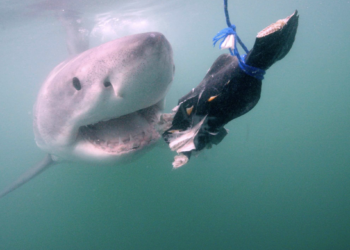
When viewers see a Great White shark leaping from the water or a Bull shark investigating a “dinner bell” in Florida, they are largely looking at Discovery Shark Week real footage. The scientific community’s involvement ensures that the core behaviors captured on film—such as the hunting tactics explored in “Secrets of the Great White Kill”—are authentic.
Real footage includes:
The precise orca attacks on Great White sharks documented in “Jaws vs Orca.”
The erratic swimming patterns of sharks in the Marshall Islands investigated in “Expedition X: Atomic Sharks.”
The record-setting freefall dive attempted by high diver Molly Carlson in “Ultimate Shark Dive.”
These moments are the result of experts like Dr. Tristan Guttridge and Forrest Galante pushing boundaries in high-intensity investigations. When a shark reacts to a “chum island” or a cognitive cue, those interactions are happening in real-time, documented by cameras that are often just inches away from the action.
What is Recreated
The controversy surrounding “is shark week fake” often stems from the use of dramatic recreations and high-concept storytelling. While the sharks themselves are real, certain narrative elements may be enhanced for television. For example, “Jurassic Sharks” openly utilizes “revolutionary CGI” to resurrect prehistoric species. This is not meant to deceive, but to merge real-world expeditions with visual effects to tell a story that cannot be captured with modern cameras.
Recreated or dramatized elements often include:
Historical reenactments of famous encounters, such as the USS Indianapolis tragedy explored by Josh Gates.
Narrative “whodunnit” structures, like the search for a specific “killer” shark in Australia.
The use of “massive blood bombs” or lures to guarantee activity within a limited filming window.
While these techniques help maintain “nonstop action,” they represent the “scripted” or produced side of the event, where scientists and filmmakers collaborate to create a compelling “predator spectacle.”
Expert Commentary
The credibility of Shark Week rests on its roster of returning experts. Scientists like Dr. Riley Elliott and conservationists like Rosie Moore provide the backbone for these specials. According to Joseph Boyle, Head of Content at Discovery Channel, the event is built on a “legacy of pioneering science.”
However, experts often have to balance their research goals with the demands of “bold storytelling.” In “How to Train a Great White,” the team uses Navy-pioneered techniques to test shark intelligence. While the experiment is a legitimate investigation into cognitive tasks, the framing of the episode is designed to be a “must-see cultural moment.” Experts serve as the bridge between the raw data and the “blockbuster” presentation the audience expects.
Final Verdict
So, are Shark Week episodes real? The final verdict is that Shark Week is a hybrid of authentic marine biology and high-end entertainment. The encounters with apex predators, the tagging of “Big Rose,” and the investigation into “mutant” sharks are based on real expeditions and genuine scientific curiosity.
The “scripted” feel often comes from the post-production process—the dramatic music, the intense narration, and the framing of a “Sharkzilla” investigation. While some episode concepts are deliberately larger than life and presented with a dramatic hook, the heart of the program remains a celebration of the raw power and intelligence of sharks.
For the viewer, the truth lies in the middle: the sharks are 100% real, but their stories are told through the lens of a world-class television production.