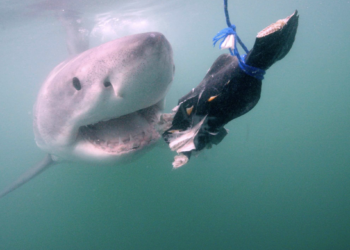
Explore the science behind the ‘Atomic Sharks’ of the Marshall Islands nuclear zone as Discovery’s Shark Week 2026 investigates the impact of 67 nuclear blasts on apex predators.
The deep blue has always held a certain level of mystery, but nothing captures the imagination quite like the prospect of “mutant” predators lurking in the shadows of history. As Discovery Channel gears up for the 2026 return of its legendary Shark Week, one investigation is already sending ripples through the scientific community and fan circles alike. The Expedition X: Atomic Sharks special, scheduled to air on Wednesday, July 29, 2026, at 8 PM ET/PT, promises to dive headfirst into one of the most chilling intersections of military history and marine biology.
The investigation takes researchers Phil Torres and Heather Amaro 5,000 miles west of the United States to the remote Marshall Islands. This region is home to the world’s largest shark sanctuary, but it also carries a heavy legacy: between 1946 and 1958, the U.S. military detonated 67 nuclear bombs in these waters. Decades later, reports of erratic swimming patterns and highly aggressive behaviors among the local apex predators have sparked a haunting question: Are we seeing the long-term effects of radiation on the ocean’s most formidable hunters?
What are Atomic Sharks?
The term “atomic sharks” sounds like something straight out of a mid-century sci-fi flick, but the investigative science tone of the upcoming special suggests a reality grounded in environmental impact. In the context of the Marshall Islands, the term refers to shark populations that inhabit former nuclear testing sites, specifically the Bikini and Enewetak Atolls.
For the Expedition X team, the mission isn’t just about finding monsters; it is about understanding how these animals have adapted to a nuclear zone. The sharks in these areas are reportedly exhibiting behaviors that differ significantly from their counterparts in non-irradiated waters. Aggression levels are said to be off the charts, and swimming patterns appear frantic, leading to local rumors of “mutant” sharks that have been fundamentally altered by the residual energy of 67 atomic blasts.
Why radiation areas are studied
Scientists study nuclear zones like the Marshall Islands because they serve as inadvertent, long-term laboratories for evolutionary biology. When the U.S. military concluded its testing in the late 1950s, it left behind a marine environment saturated with radioactive isotopes. By examining the apex predators at the top of the food chain, researchers can see how toxins bioaccumulate and whether high-energy radiation causes genetic drift or physical mutations over several generations.
For Phil Torres and Heather Amaro, the sharks represent a biological “canary in the coal mine.” If the sharks are behaving erratically, it indicates a systemic shift in the reef’s health. Understanding how life persists in a nuclear zone helps scientists predict the long-term resilience of marine ecosystems in the face of human-induced environmental disasters.
Are sharks affected by nuclear zones?
The question of whether sharks are affected by nuclear zones is at the heart of the radioactive sharks discovery. Historically, sharks are known for their incredible resilience and high immunity, but even they have limits. Radiation + mutation fear hooks often suggest physical deformities—extra fins or glowing eyes—but the scientific reality is usually more subtle and more dangerous.
Radiation can affect the central nervous system of marine animals, which explains the “erratic swimming” reported by the Expedition X team. Furthermore, if the prey of these sharks is contaminated, the sharks receive a concentrated dose of radiation every time they eat. This can lead to hormonal imbalances, increased irritability, and heightened predatory aggression. While we may not see Godzilla-sized mutations, the behavioral shifts can turn a standard reef shark into a much more unpredictable and dangerous encounter for divers.
Expedition findings
While the full breadth of the expedition findings will be revealed during the Shark Week premiere on Wednesday, July 29, 2026, early reports from the field suggest that the team encountered more than they bargained for. Diving into the Marshall Islands sanctuary, Torres and Amaro documented sharks that seemed to lack the typical “caution” usually seen in reef species.
Using specialized equipment to monitor both the water’s radioactivity and the sharks’ physiological responses, the team tracked the movement of these predators through the craters left by atomic detonations. The footage reportedly shows sharks congregating in areas where radiation levels remain higher than the ocean’s baseline, suggesting a strange attraction to or a lack of sensitivity toward these contaminated zones.
Reality check
It is important to provide a reality check when discussing “atomic” or “mutant” animals. While the term creates a compelling hook for television, the scientific community is careful to distinguish between behavioral changes and true genetic mutation. Most “mutations” in the wild are not beneficial and usually result in offspring that do not survive to adulthood.
The “mutant” sharks mentioned by locals are likely individuals with high levels of stress or neurological interference caused by the environmental conditions of the atolls. However, the fact remains that these sharks are living in an environment that was once the most radioactive place on Earth. Even if they haven’t grown second heads, their existence in these zones is a testament to the shark’s status as a survivor.
Final verdict
The final verdict on the atomic sharks of the Marshall Islands remains a work in progress, but the Expedition X investigative team is bringing the data to the surface. Shark Week 2026 is positioning this episode as a centerpiece of its “heart-pounding investigations,” and for good reason. It forces us to look at the lasting footprint of the nuclear age on a species that has survived for millions of years.
Whether these sharks are true mutants or simply victims of a stressed environment, their story is a powerful reminder of the ocean’s mystery. Be sure to tune in to Discovery on Wednesday, July 29, 2026, at 8 PM ET/PT to see the footage for yourself and decide if the atomic shark is a myth or a terrifying new reality.