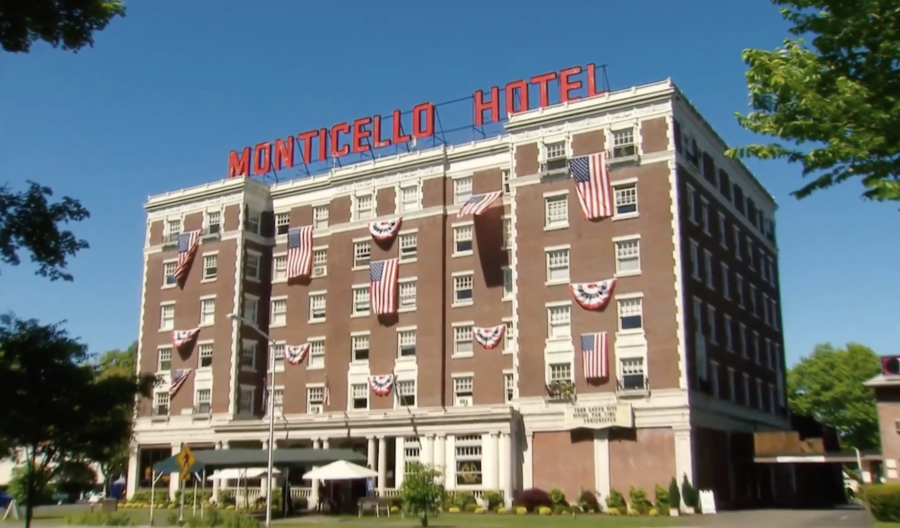
Discover the history of the Monticello Hotel in Longview, Washington, from its 1923 opening and Hotel Hell appearance to its restoration and new life today.
For more than a century, the Monticello Hotel has been one of the most recognizable landmarks in Longview, Washington. Since opening in 1923, the six-story Georgian Revival building has witnessed the city’s growth from a carefully planned industrial community into the modern city it is today. Along the way, it has welcomed generations of travelers, hosted countless celebrations, survived changing ownership, endured financial hardship, found itself in the national spotlight on Gordon Ramsay’s Hotel Hell, and ultimately reinvented itself for a new era.
Today, although it no longer operates as a traditional hotel, the Monticello remains an important part of downtown Longview. Thanks to extensive restoration work and adaptive reuse, the historic building has been given a new lease on life while preserving the architectural character that has defined it for more than 100 years.
Here’s the complete story of the Monticello Hotel—from its ambitious beginnings and years of decline to its nationally televised struggles and remarkable rebirth.
The Grand Opening of Longview’s First Landmark
When the Monticello Hotel officially opened its doors on July 14, 1923, only days after the formal dedication of the new city of Longview, it symbolized the ambitious vision of lumber baron R.A. Long.
Long had envisioned Longview as a carefully planned industrial city, and the Monticello Hotel was designed to leave a lasting first impression on investors, business leaders, and visitors arriving in the community.
The hotel was designed by the respected Kansas City architectural firm Hoit, Price and Barnes, whose work reflected the elegant Georgian Revival style that was popular during the period. Standing six stories tall at 1405 17th Avenue, the building quickly became the architectural centerpiece of downtown Longview.
Inside, guests were greeted by an impressive grand lobby adorned with murals created by renowned Western artist Joe Knowles. The hotel featured elegant public spaces, comfortable guest rooms, dining facilities, and ballrooms that soon became the setting for weddings, civic events, business meetings, and social gatherings.
For decades, the Monticello Hotel served as Longview’s premier destination for visitors. Business travelers, tourists, local residents, and dignitaries all passed through its doors, helping establish the hotel as the city’s social and hospitality hub.
Throughout its long history, the building survived economic downturns, changing travel habits, floods, and multiple ownership changes. At one point, the property was even gifted to the City of Longview.
However, like many historic hotels across America, maintaining such a large and aging building gradually became more difficult. By the late twentieth century, rising operating costs, increased competition from newer hotels, and years of deferred maintenance had begun taking their toll.
The Phillip Lovingfoss Years
The hotel entered another important chapter in the early 2000s when Phillip (also spelled Philip in some court and public records) Guy Lovingfoss became its owner. His connection to the Monticello stretched back much further than his ownership.
As he later explained during Hotel Hell, his mother had worked at the hotel while he was growing up, giving him a lifelong connection to the historic property. Years later, in his early thirties, Lovingfoss worked there himself as a bartender.
It was during that period that he met Annabelle Lee White Juell, who owned the Monticello Hotel. The two eventually married, and following Juell’s death in 2004, Lovingfoss inherited the property.
Around the time he acquired ownership, the couple reportedly invested approximately $300,000 into restoring portions of the historic building, hoping to preserve one of Longview’s most treasured landmarks.
Despite those efforts, operating a historic hotel proved increasingly difficult. As the years passed, the building began showing signs of financial and operational strain.
By the early 2010s, only a relatively small number of rooms inside the original historic hotel were consistently available for overnight guests. Many visitors were instead accommodated in an adjoining motel section, while several rooms inside the historic building had reportedly become filled with personal belongings rather than being rented to guests.
Maintenance issues also became more noticeable throughout the property. The restaurant, lounge, and banquet facilities struggled to maintain consistent quality, while the aging infrastructure required increasingly expensive repairs. At the same time, operating costs continued to climb, making it difficult for revenue to keep pace.
Reports from the period indicated that the hotel was operating at a significant monthly loss, with the costs of maintaining the nearly century-old building outweighing its income.
The challenges facing both the hotel and its owner would soon attract national attention when Gordon Ramsay arrived to film Hotel Hell. For a closer look at Phillip Lovingfoss’s personal journey, legal troubles, and what happened after the cameras stopped rolling, read our in-depth feature on here.
Gordon Ramsay Brings the Monticello Into the National Spotlight
The Monticello Hotel received national attention in June 2013, when Gordon Ramsay and the production team behind Hotel Hell arrived in Longview to film what would become Season 2, Episode 2 of the series. The episode eventually aired on July 28, 2014, introducing millions of viewers to both the historic hotel and the challenges it was facing.
During his visit, Ramsay identified numerous operational problems throughout the property.
He criticized the fact that only a limited number of rooms inside the original hotel were available for guests, while many visitors were instead directed to the adjoining motel. He also highlighted maintenance concerns, cleanliness issues, and a restaurant menu that relied heavily on frozen ingredients, including shrimp, along with packaged items such as ravioli.
Beyond the physical condition of the hotel, the episode focused heavily on the leadership challenges facing the business.
Owner Phillip Lovingfoss’s struggle with alcohol became one of the episode’s central storylines. Ramsay repeatedly encouraged him to seek help, while Chef Dan Laney, who had been sober for several years himself, offered to support Lovingfoss in his recovery. The program also featured extensive renovations, redesigned guest rooms, and an updated restaurant menu aimed at giving the Monticello a fresh start.
One of the most dramatic developments, however, happened away from the cameras. During the filming of Hotel Hell, Lovingfoss was arrested on suspicion of driving under the influence (DUI) near the hotel and production area. Although the incident did not become a major focus of the broadcast episode, it added another layer to what was already an extraordinarily difficult period for both the owner and the hotel.
While the episode concluded with optimism, including renovations and Lovingfoss’s commitment to enter a recovery program, many of the underlying financial and operational challenges remained unresolved.
After Hotel Hell: Financial Struggles Continue
Despite the exposure generated by Hotel Hell, the Monticello Hotel’s financial situation continued to worsen. In January 2014, several months after filming but before the episode aired, Lovingfoss announced the closure of the hotel’s restaurant, lounge, and banquet facilities, saying he wished to pursue other endeavors.
Although the hotel and adjoining motel rooms remained open for a period, losing those food, beverage, and event operations significantly reduced the property’s revenue.
Over the following years, the hotel continued to face mounting financial pressure. Public records documented ongoing debts, liens, creditor actions, and repeated efforts to either lease or sell the property as ownership searched for a path forward.
By 2016, the Monticello Hotel had officially been placed on the market. Later that year, or in early 2017, ownership transferred to new investors, bringing Phillip Lovingfoss’s tenure as owner to an end.
A Multimillion-Dollar Restoration Gives the Monticello New Life
The sale of the property marked the beginning of one of the most significant restoration projects in the hotel’s history.
A Seattle-based investment group, working alongside local partners, acquired the Monticello and committed substantial resources to preserving the landmark. Reports indicated that the purchase price was approximately $2.8 million, followed by millions more invested in extensive renovations.
Rather than demolishing the aging building, the new owners embraced an adaptive reuse approach that balanced historic preservation with modern living. The restoration included structural improvements, upgraded mechanical systems, careful preservation of historic architectural details, and extensive interior rehabilitation.
Many of the building’s defining features—including portions of the original plasterwork, the grand lobby, ballroom elements, and exterior façade—were carefully restored while modern amenities were incorporated throughout the property.
One of the biggest changes involved converting the upper floors into approximately 68 market-rate apartments, offering a mix of studio and larger residential units.
Meanwhile, the ground floor retained commercial space suitable for restaurants, cafés, retail businesses, and community events. Over the years, several restaurant concepts have operated from these spaces, including a popular wood-fired pizzeria and other dining ventures.
By 2017 and 2018, the majority of the restoration work had been completed. Rather than continuing as a traditional full-service hotel, the Monticello had successfully evolved into a mixed-use historic building that combined residential living with commercial activity.
By 2019, overnight hotel operations had largely come to an end, with the property fully embracing its new identity. The building has changed ownership again in more recent years, reflecting continued investment in downtown Longview and the enduring appeal of one of the city’s most iconic properties.
The Monticello Hotel Today
Today, the former Monticello Hotel remains one of Longview’s best-preserved historic buildings and is an important stop along the city’s Civic Center Historic Walking Tour.
Although visitors can no longer book overnight stays as they once could, the building continues serving the community in new ways. Its apartments provide modern housing within a beautifully restored historic structure, while the ground-floor commercial spaces continue hosting restaurants, cafés, and businesses that help keep the building active throughout the day.
The transformation stands as an excellent example of successful historic adaptive reuse—demonstrating how older buildings can be preserved while meeting the practical needs of modern communities.
Rather than allowing the Monticello to fall further into decline, developers found a sustainable future that respected both its history and its architectural significance.
Why the Monticello Hotel’s Story Matters
The story of the Monticello Hotel reflects challenges faced by countless historic hotels across the United States. Many beautiful older properties struggle with rising maintenance costs, changing travel habits, increased competition from modern hotel chains, and the financial realities of operating aging buildings.
The Monticello experienced all of those pressures. Its appearance on Hotel Hell introduced those challenges to a national audience, while its eventual restoration demonstrated that historic buildings can still thrive when preservation is combined with thoughtful investment and adaptive reuse.
From its role in R.A. Long’s vision for a brand-new city to its reinvention as a restored residential and commercial landmark, the Monticello has continually adapted to changing times.
Its years under Phillip Lovingfoss, its nationally televised appearance, and its multimillion-dollar restoration have all become chapters in a much longer story that continues today.
A Historic Landmark With a New Purpose
The Monticello Hotel may no longer operate in the same way it did when it first welcomed guests in 1923, or even during its appearance on Hotel Hell, but its story is far from over.
Today, the building remains one of downtown Longview’s defining landmarks—a reminder of the city’s earliest ambitions and its ongoing commitment to preserving its history.
Whether admired for its elegant Georgian Revival architecture during a walking tour, visited for its ground-floor businesses, or experienced as a residential apartment building, the Monticello continues to play an important role in Longview more than a century after it first opened its doors.
Its journey—from grand opening, through decades of change, financial hardship, national television exposure, and ultimately a thoughtful restoration—shows that even the most challenged historic landmarks can find new purpose while preserving the character that made them special in the first place.