Inside the groundbreaking science and high-speed cinematography capturing the legendary Great American Breach during Shark Week 2026.
The return of Discovery Channel’s Shark Week in 2026 brings with it a fascinating investigation into one of the most high-octane displays in the natural world: the airborne assault of the great white shark. In the highly anticipated special Air Jaws: Red, White and Breach, researchers are pivoting their focus toward the American coastline to document a phenomenon that was once thought to be exclusive to the waters of South Africa. As great whites increasingly appear in California and beyond, the mechanics of the great American breach are finally being decoded by the world’s leading marine experts.
What is Air Jaws about?
The Air Jaws franchise has spent decades documenting the world’s most athletic sharks. This latest installment, Air Jaws: Red, White and Breach, specifically tracks the emergence of breaching behavior along the United States coastline.
While Shark Week has historically traveled to Seal Island in False Bay, South Africa, to witness these four-ton predators launch themselves into the air, new footage reveals that great whites are now performing these epic maneuvers off the coast of California with unprecedented frequency. Filmmaker Jeff Kurr, marine biologist Alison Towner, and cinematographer Andy Casagrande lead the expedition to uncover why these legendary sharks have brought their aerial game to American shores.
Why sharks breach out of water
At its core, the air jaws shark breaching phenomenon is an exercise in extreme predatory efficiency. Great white sharks are ambush hunters that rely on the element of surprise. By patrolling the depths and looking upward, they identify the silhouette of prey—typically seals or sea lions—against the surface light.
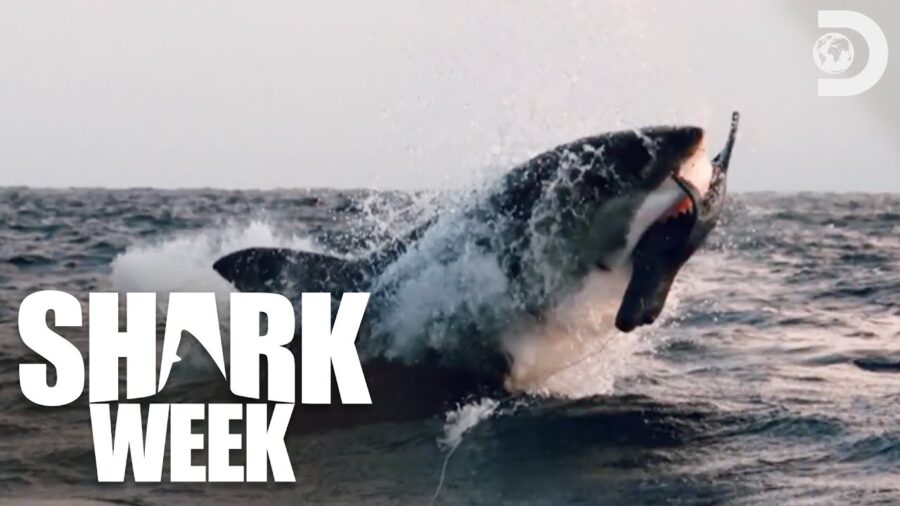
To catch such agile mammals, the shark must generate immense vertical speed. When a shark hits the surface at speeds exceeding 25 miles per hour, the resulting momentum carries its entire body out of the water. This great white breaching documentary footage illustrates that the breach is not for show; it is a tactical strike designed to incapacitate prey instantly, preventing a prolonged and energy-consuming chase.
Famous hunting technique explained
The shark breach footage explained in this special highlights the physics of the “Polaris attack.” Scientists have noted that the success of a breach depends on the angle of the strike and the depth of the water. In the coastal hotspots featured in Air Jaws: Red, White and Breach, the seafloor topography allows sharks to make these vertical charges.
The documentary explains that for a great white to successfully breach, it must swim nearly vertically from the depths. This hunting technique is the most energy-intensive behavior in the shark’s repertoire, meaning it is only utilized when the potential caloric reward of a high-fat seal justifies the massive exertion.
Filming methods used
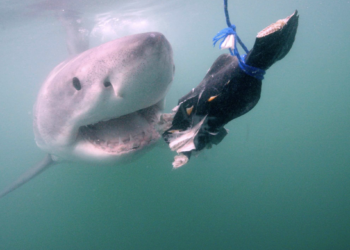
Capturing these split-second events requires pioneering technology and immense patience. The filming methods used in the 2026 special include high-speed “Phantom” cameras capable of shooting thousands of frames per second, allowing the team to analyze the Great American Breach in slow motion. To trigger the behavior safely for study, researchers often use “towed decoys”—foam seals pulled behind a vessel—to mimic the movement of prey.
Additionally, the team utilized innovative tagging technology to track the sharks’ depth and speed leading up to the jump, providing a data-driven look at the raw power required to break the surface.
Iconic breaching behavior science
Beyond the spectacle, the special dives into the iconic breaching behavior science to determine if environmental shifts are driving sharks closer to US beaches. The presence of these “Air Jaws” in American waters suggests a robust recovery of prey populations or a shift in traditional hunting grounds.
By studying the bite patterns and forensic evidence of these breaches, Towner and her team are redefining shark intelligence, showing that these apex predators adapt their hunting tactics in real time based on their geographic location.
Final explanation
The final explanation offered by the Air Jaws: Red, White and Breach team confirms that the American coastline has become a new frontier for great white athleticism. The “Great American Breach” is no longer a rare anomaly but a documented part of the Pacific and Atlantic ecosystems.
As Shark Week 2026 continues to push the boundaries of marine investigation, it becomes clear that the great white shark remains the ocean’s most formidable and adaptable predator, capable of turning the surface of the sea into a high-stakes battlefield anywhere in the world.